Smithsonian National Museum of Natural History

Find Your Place: Interactive U.S. Map

This map links to images and information about select collection objects from each U.S. state and territory. These objects are all in permanent exhibits at the museum, so you can see them when you visit.

How to Use the Map

  • Choose a state or territory in one of three ways: Use the dropdown menu, click on a state on the map, or choose a state in the sidebar panel.
  • The sidebar will expand to display an image of the object, a short description of it, and links to get more information about it.

  • Mounted, articulated skeleton of a fossil whale, Basilosaurus cetoides

    Alabama

    Basilosaurus
  • the skeleton of a woolly mammoth

    Alaska

    Woolly Mammoth (composite)
  • Skeleton of a large bat in a display case with its arms bent like the letter W and long fingers coming down off the end of each arm.

    American Samoa

    Samoan Fruit Bat
  • Two very large pieces of blackish-brown rock in a museum display case. The top one is gumdrop-shaped and has a large hole in it and its surface looks smooth, but has many indentations. The bottom one is just as wide as the top piece, but only one-third as tall with no holes. It also has a smooth surface with indentations.

    Arizona

    Tucson Meteorite
  • Huge cluster of sparkling white and clear quartz crystals

    Arkansas

    Berns Quartz
  • Saber-toothed cat

    California

    Saber-tooth Cat (composite)
  • Complete fossil Stegosaurus skeleton displayed vertically, with the bones in a bit of a jumble. The head is on the right side, many of the ribs are right next to each other, the feet are not all pointing down, and some of the plates are not on its back.

    Colorado

    Stegosaur, plated dinosaur
  • Large brown and gray rock on a platform in an exhibit case, with two other rocks or minerals above it.

    Connecticut

    Kyanite-Chlorite Schist
  • Shiny white mineral with thin striations on its surface. Below the mineral is an exhibit label reading Plagioclase.

    Delaware

    Feldspar
  • Two taxidermy passenger pigeons sitting on a branch in an exhibit case.

    District of Columbia

    Passenger Pigeon
  • Manatee skeleton mounted on a wall. It has a small skull, larger rib cage, and a fairly long tail. It also has two arms.

    Florida

    Manatee
  • Thin, white rock mottled with gray. The rock has 11 pockets in it of various sizes, making it look like a misshapen egg carton.

    Georgia

    Quartz
  • Armadillo with baby armadillos nursing

    Guam

  • Brown slab of rock with five stalactites of the same color dripping down its face.

    Hawaii

    Basalt Stalactite
  • Large, dark gray triangular shaped rock with many dimples in it. The rock is on a museum display platform with a label behind it titled Oakley.

    Idaho

    Oakley Meteorite
  • Large, purple crystals of fluorite on a yellow rock base in an exhibit case. The crystals are nine large cubes positioned at different angles to each other.

    Illinois

    Fluorite
  • Articulated fossil skeleton of an American mastodon in a museum exhibit. The view is from the side, showing part of the tusks, the skull with teeth, neck, upper forelegs, and part of the rib cage.

    Indiana

    American Mastodon (composite)
  • Pentagonal piece of rock with three or four fossil crinoids embedded in it. The crinoids are protruding out of the rock. One looks like an octopus with 26 legs, while the others look like flowers on long, ribbed stalks.

    Iowa

    Platycrinus symmetricus
  • Mounted fossil skeleton of a long, thin creature with a small head, limbs that appear to be flippers, and a long tail

    Kansas

    Mosasaur (composite)
  • Tan and white fossil sea urchin skeleton, roughly spherical in shape but with ridges and troughs running from top to bottom, like an acorn squash.

    Kentucky

    Melonechinus indianesis
  • Articulated medium-size turtle skeleton in a display case with other turtle skeletons.

    Louisiana

    Alligator Snapping Turtle
  • A taxidermy specimen of a medium-size furry, brown mammal similar to a fox or marten, standing on a fake log in an exhibit display.

    Maine

    Fisher
  • Large fossil mounted on a pole in front of a painting of an underwater scene. The fossil is long and horizontal, with two big eye sockets and what looks like a long jawbone.

    Maryland

    Baleen Whale (skull)
  • Atlantic White-Sided Dolphin

    Massachusetts

    Atlantic White-sided Dolphin (model)
  • Large, wavy sheet of copper mounted on a wall. The copper has black splotches and striations on it.

    Michigan

    Copper
  • Large piece of gray rock with white speckles, sitting on a pedestal in an exhibit display.

    Minnesota

    Olivine Gabbro
  • Articulated skeletons of two bony fish in an exhibit case titled, Carps, Catfishes, and Their Relatives. One fish is three times as long and much larger than the other.

    Missouri

    Blue Catfish
  • Close up of of the skull of an articulated T. rex skeleton biting the frill of a Triceratops skeleton.

    Montana

    Theropod Dinosaur
  • Fossil of a small animal embedded in brownish-yellow rock. The skull has two prominent upper canine teeth. An arm extends from just below the skull, ending in a hand with three fingers. There is also a rib cage, spine, and two legs.

    Nebraska

    Beaver (cast) inside fossil burrow
  • A red, green, and black opal that is oval in shape.

    Nevada

    Opal
  • Large blue, brown, and white stone with six flat sides.

    New Hampshire

    Beryl
  • Dozens of rocks of different sizes and shapes glowing fluorescent green, orange, and red in a dark exhibit case.

    New Jersey

    Sterling Hill Mine Specimens
  • Large mineral specimen consisting of many light blue crystals of Smithsonite. It is sitting on a pedestal in an exhibit case. Underneath the mineral is a label, reading Smithsonite, Zn CO 3, Kelly mine, Soccoro County, New Mexico.

    New Mexico

    Smithsonite
  • Dark brown fossil embedded in a sandy colored rock. The fossil is a creature with a segmented body that tapers into a pointed tail. It has two eyes on top of the left end of its body, and just behind the eyes are two paddle-like appendages jutting out on opposite sides of the body.

    New York

    Eurypterid Arthropod
  • Large, open fossil shark jaws with huge teeth. Behind, or inside, the jaws are eight people to show the scale of exactly how big the jaws are.

    North Carolina

    Carcharocles megalodon
  • Two white and brown fossil fan-shaped leaves embedded in a piece of brown, yellow, and white rock.

    North Dakota

    Ginkgo Tree Leaf
  • Black fossil skull of an armored fish. Its jaws are open and have two very large canine teeth on both the upper and lower jaws. There is a large eye socket above the upper jaw.

    Ohio

    Armored Fish
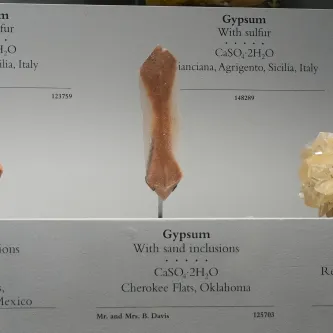
  • Thin piece of clear gypsum, with brown grains in it that form an hourglass shape. The gypsum in on a shelf in an exhibit case. Below it is a label reading, Gypsum with sand inclusions, CA SO4 H2O, Cherokee Flats, Oklahoma.

    Oklahoma

    Gypsum
  • A beaver skull attached to a wall in an exhibit. The jaws have four prominent incisor teeth in the front, two on top and two on the bottom. Farther back in the mouth are four flatter sets of molars.

    Oregon

    Beaver
  • A large piece of fossilized tree bark that looks like a car or truck tire tread.

    Pennsylvania

    Lycopsid Tree Trunk Model
  • Slab of brown rock with eight lighter brown and white, circular fossils in it. The fossils are segmented and look like wheels or tires.

    Puerto Rico

    Praebarrettia coatesi
  • White and lavender quartz crystals

    Rhode Island

    Quartz (var. amethyst)
  • Tan fossil sand dollar with 9970 written on it. There is a round hole near the bottom of the fossil.

    South Carolina

    Encope macrophora
  • Articulated skull and neck bones, or upper spine, of an animal with large canine teeth in the front of its jaw, with flat molars behind them.

    South Dakota

    Marsupial Mammal (composite cast)
  • Fossil of dozens of cylindrical corals in two clumps, one atop the other. The fossil is in a display case, next to four items to its left and above three other items.

    Tennessee

    Acrocyathus proliferus
  • Exhibit display case with an articulated skeleton of a dinosaur-like creature with dozens of spines protruding from its back to form an arc or sail. The skeleton has four legs, a long tail, and a large skull with many big, sharp teeth.

    Texas

    Early Synapsid (composite)
  • A family looks out over Henry the elephant in the rotunda of the museum.

    U.S. Virgin Islands

  • Front half of an articulated fossil diplodocus skeleton in an empty exhibit hall.

    Utah

    Sauropod Dinosaur (composite)
  • Brown, maroon, and black fossil trilobite in a piece of tan rock.

    Vermont

    Trilobite
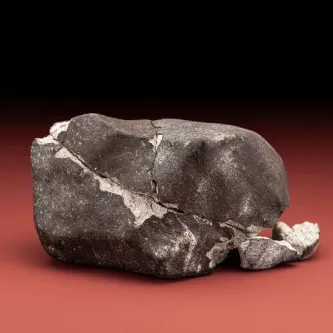
  • Lorton meteorite

    Virginia

    Lorton Meteorite
  • Short columns of gray rock on an exhibit platform. Most are bunched together in a rough circle, with cracks separating them. Many have five or six uneven sides.

    Washington

    Columnar Dacite Lava
  • Adult black bear with a tiny cub next to it in an exhibit case.

    West Virginia

    American Black Bear
  • A porcupine sitting on its hind legs on a log in an exhibit.

    Wisconsin

    North American Porcupine
  • Complete skeleton of an early horse embedded in a slab of rock.

    Wyoming

    Early Horse (skeleton)